Secure Login and Role Access
Define customer, vendor, employee, manager and administrator permissions according to responsibility.
A useful portal gives each user the information and actions relevant to their role. We build connected customer, partner, vendor and employee platforms that replace scattered requests with clear self-service workflows.
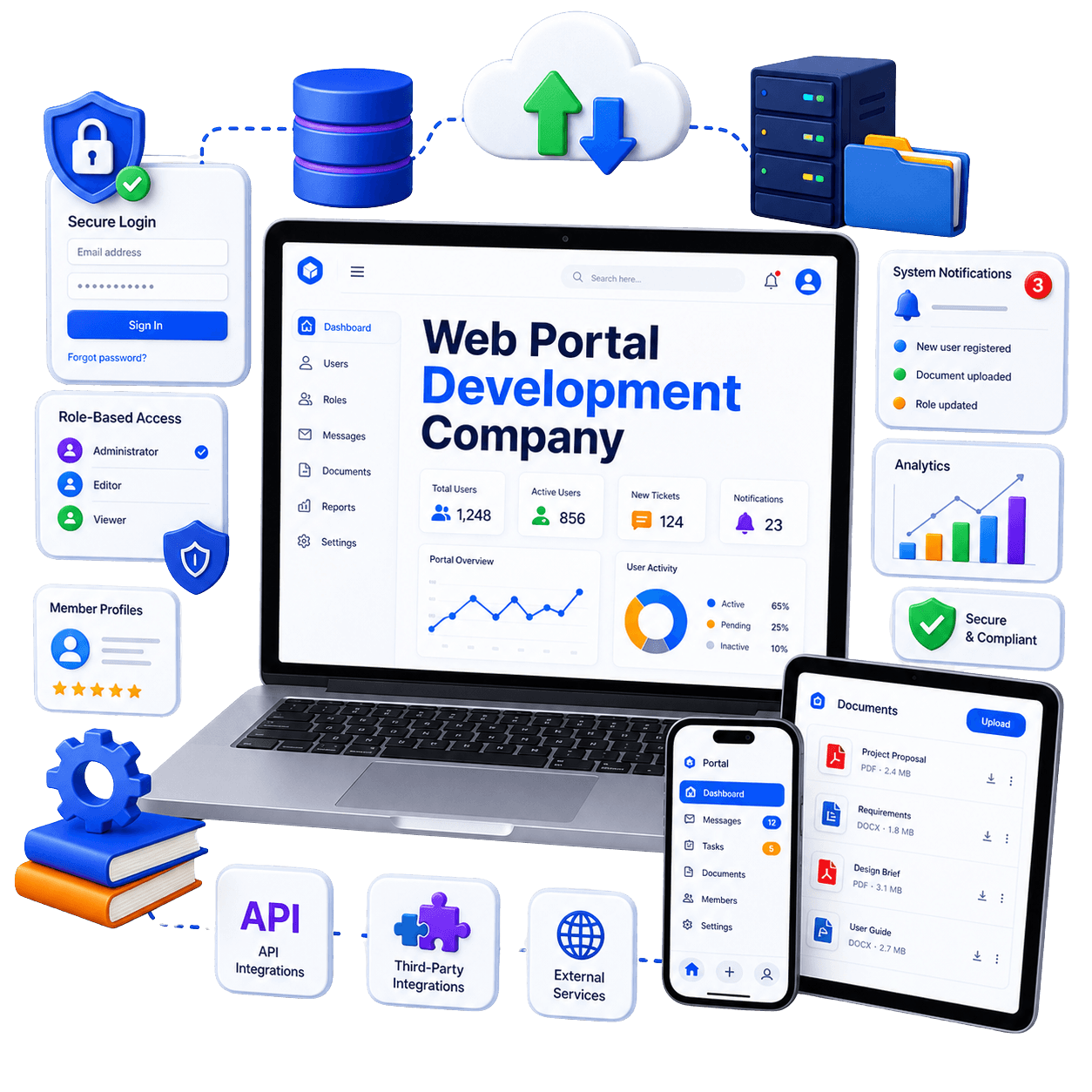
Businesses often share important information through email threads, spreadsheets and phone follow-ups because customers, vendors or employees have no reliable place to access it themselves. A well-designed web portal brings those recurring tasks into one controlled environment.
We begin by separating user roles and responsibilities. A customer may need orders, documents and support; a vendor may need purchase requests and submissions; an employee may need approvals and records. Each dashboard should show only what that user needs and is authorised to access.
The portal backend, database and integrations are planned together so information remains consistent with existing business systems. Security, audit trails, notification rules and administration are considered early because the portal becomes part of everyday operations after launch.
This matters in practice more than it sounds. A distributor network spread across several states needs dealers to check stock and place orders without calling the sales office every time. A hospital group needs patients to book appointments and view reports without front-desk staff repeating the same lookup all day. The workflow is different in each case, and the portal is built around whichever one actually applies to your business.
Portal modules are selected around the people, data and transactions involved in your actual workflow.
Define customer, vendor, employee, manager and administrator permissions according to responsibility.
Show relevant records, tasks, alerts and actions instead of one generic screen for every user.
Manage approved uploads, downloads, forms and review statuses through controlled workflows.
Route requests, decisions, comments and exceptions to the correct authorised team members.
Connect supported ERP, CRM, payment, identity or internal systems where secure access exists.
Manage users, master data, activity and operational reports from a central administration area.
We develop business, industry and service portals with workflows designed for their specific users, records, transactions and administration needs.
Users can access approved information and complete routine requests without repeated coordination.
Roles and permissions reduce unnecessary exposure of business and user data.
Structured submissions and connected systems reduce duplicate and conflicting information.
Status changes and authorised actions can create a clearer operational history.
Users can complete supported portal tasks across desktop, tablet and mobile browsers.
New roles, workflows and integrations can be introduced against a planned architecture.
We document users, records, permissions, actions, exceptions and existing systems.
Dashboards, data relationships, security and integrations are designed together.
Modules are built and demonstrated in stages using realistic workflow scenarios.
Permissions, forms, integrations and devices are checked before user rollout and support.
Cost depends on user roles, workflows, dashboards, integrations, reports and data migration. We provide a module-wise estimate after documenting the complete requirement.
A website mainly presents public information, while a portal normally requires login and gives authorised users access to personalised data, transactions or workflow actions.
Yes. Permissions can be designed for customers, vendors, employees, managers and administrators according to what each role may view or change.
We can develop B2B, B2C, customer, vendor, dealer, employee, job, education, healthcare, real estate, e-commerce, membership, booking, travel, document and service-delivery portals. Final suitability depends on the required workflow and integrations.
Potentially, when the existing system provides a secure and documented API or supported integration method. We review authentication, data ownership and field mapping before confirming scope.
Yes. File types, size limits, storage, permissions, scanning and retention requirements are defined according to the portal’s purpose and risk profile.
Yes. The web portal is designed responsively for supported browser-based tasks. A separate mobile app may be recommended if device-specific or offline capabilities are essential.
Yes. Support can cover monitoring, backups, security updates, issue resolution, user assistance and planned module improvements.