Lead Management
Assignment, status tracking and follow-up controls.
We connect leads, visits, follow-ups and manager visibility so teams spend less time reconstructing what happened.
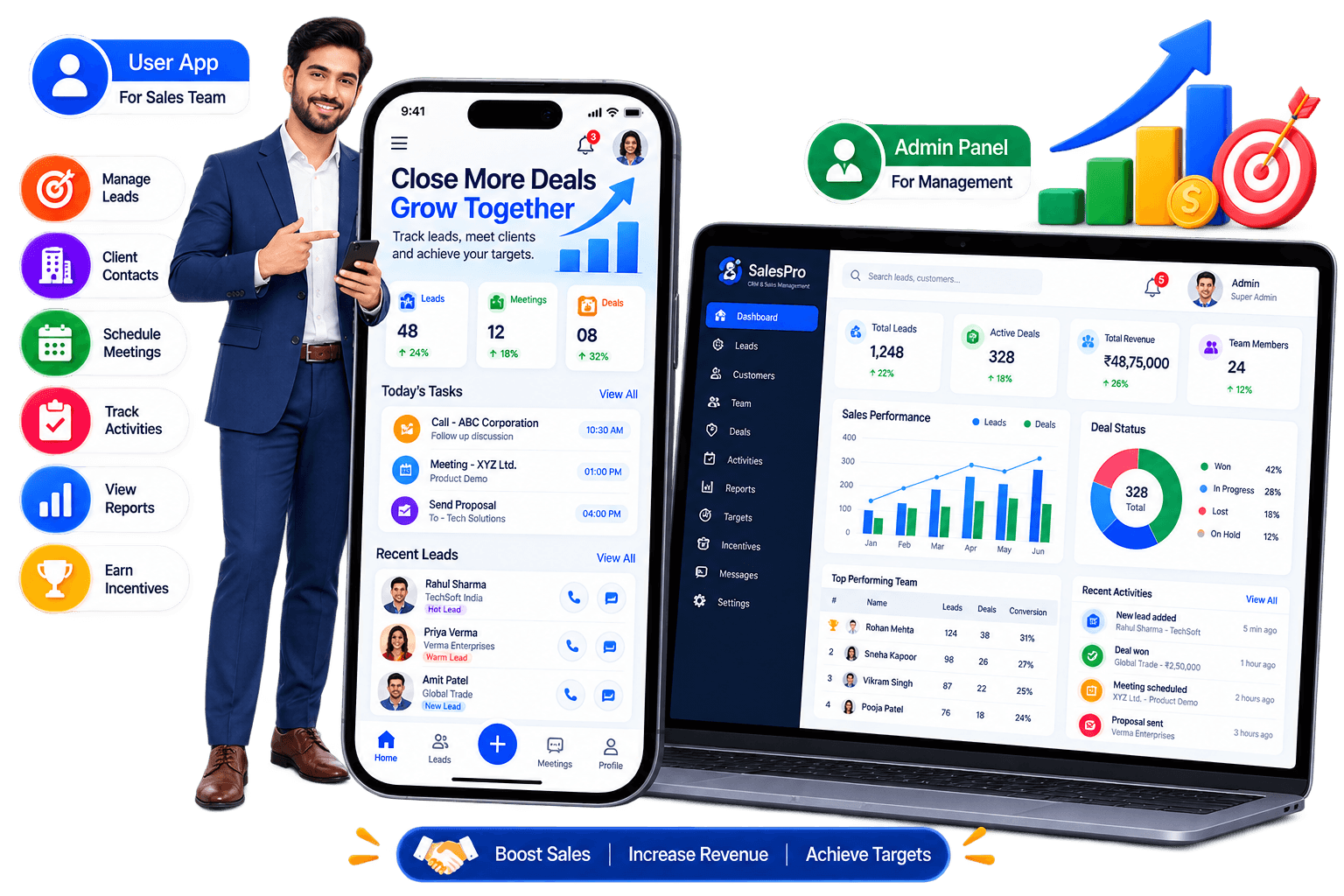
Sales teams often record visits, leads and next actions across calls, notebooks and spreadsheets. We define a consistent mobile workflow that captures the information managers and representatives genuinely need without turning every visit into excessive data entry.
Assignment, territory, follow-up and pipeline stages must match the organisation’s sales process. Offline or weak-network behaviour is considered for teams working away from the office, along with permissions for representatives and managers.
CRM connections, location data and campaign attribution are included only with clear purpose and supported access. Useful reporting then comes from consistent activity records rather than manual reconstruction at the end of a reporting period.

The scope connects customer experience, operational control and dependable technology instead of treating the app as a set of isolated screens.
Assignment, status tracking and follow-up controls.
Location-tagged visits, check-in and territory workflows.
Field-recorded orders, quotations and pricing approvals.
Two-way sync with your CRM so field and office data stay aligned.
Campaign tracking, attribution and follow-up triggers.
Pipeline, activity and outcome visibility by rep and territory.
Suitable for teams that need field activity, leads and campaigns captured consistently rather than reconstructed at the end of each week.
Priority actions remain easy to understand across common Android and iOS screen sizes.
Network calls, media and data flows are planned for practical Indian mobile conditions.
Customer, staff and administrator permissions follow actual responsibilities.
Notifications are tied to meaningful status changes instead of unnecessary interruption.
Important journeys and business events can be measured with approved analytics tools.
The architecture can accommodate new modules and integrations as usage grows.
We document users, business rules, edge cases, integrations and measurable outcomes.
Key journeys, data structures, APIs and platform choices are agreed before full development.
Working modules are demonstrated and tested in stages against realistic scenarios.
Store preparation, production checks, monitoring and planned improvements follow.
Cost depends on user roles, screens, backend modules, integrations and testing effort. We provide a module-wise estimate after documenting the complete workflow.
Yes. We can recommend native or cross-platform development after considering features, performance, budget, device access and long-term maintenance.
Yes, when operations require it. Admin roles and controls are planned around the information and actions your authorised team must manage.
Yes, when the provider offers secure documentation and suitable account access. Each data flow is reviewed before scope is confirmed.
Potentially, when the existing system offers a secure and documented API or supported integration method. We verify access and data flow before confirming scope.
Yes, we can build offline-capable visit logging and order capture that stores data locally on the device and syncs once network access returns.
We minimise collected data, use secure transmission, validation and access controls, and follow agreed retention requirements. The product owner remains responsible for applicable legal and privacy policies.
Yes. Support can cover monitoring, compatibility updates, issue resolution, store releases and planned feature improvements.