Inventory & Warehouse
Track stock across locations, batches and units with real-time visibility on movement, reorder levels and valuation.
We design and develop custom ERP software that connects inventory, finance, production, procurement, sales and HR into one dependable system built around how your business actually operates.
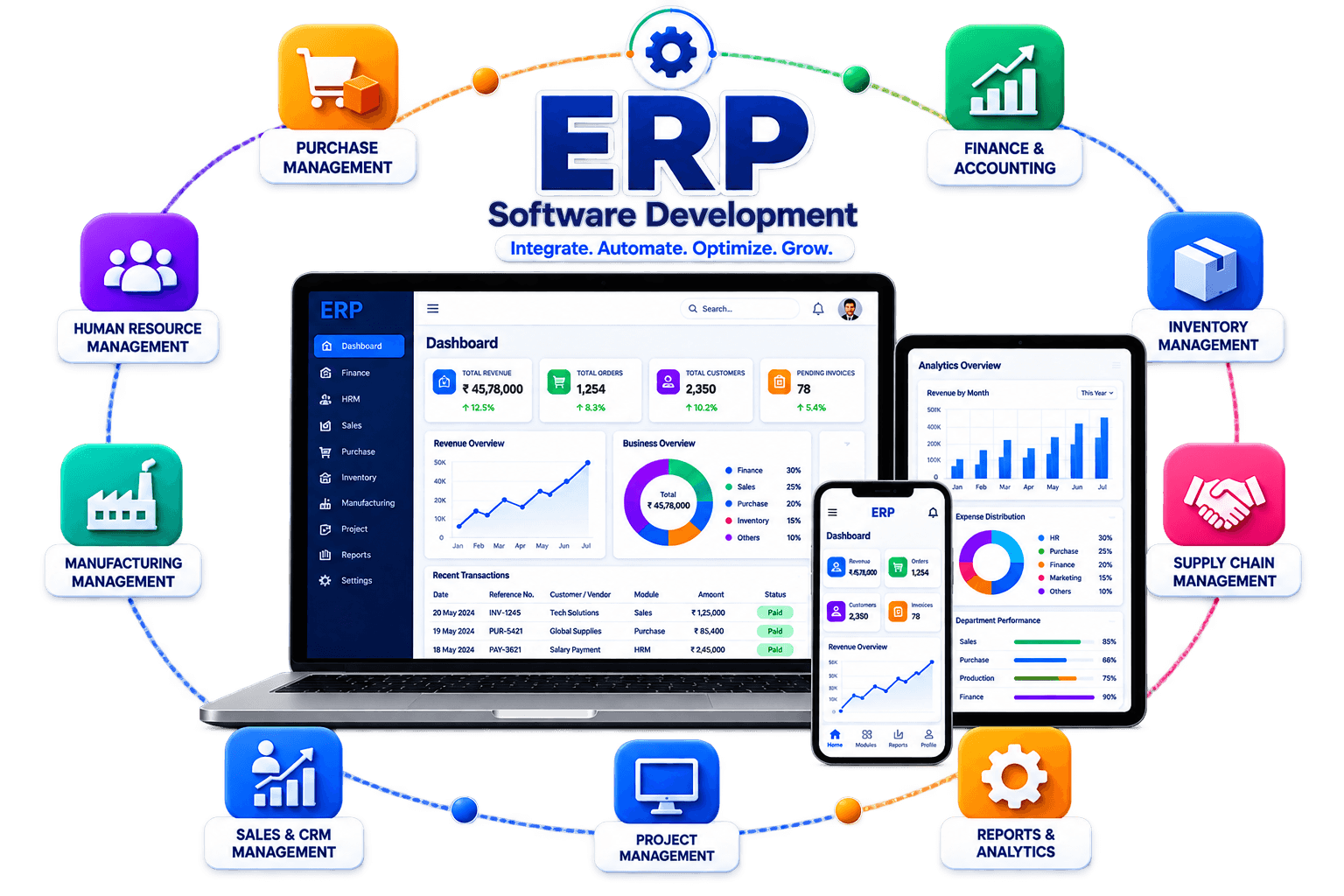
Most ERP problems do not begin with a lack of modules. They begin when the software does not reflect how your business actually raises a purchase order, tracks stock across locations, closes a production batch or approves an expense. Teams then fall back to spreadsheets, WhatsApp updates and manual registers, leaving management without a real-time, single source of truth.
Vibrant Web Tech builds ERP systems around the way your business actually works. We map departments, approval chains, stock movements, cost centres and reporting needs before deciding what belongs in each module. The result is easier for teams to adopt because daily transactions take fewer steps and the data everyone needs stays connected across departments instead of scattered across files.
Our ERP development services are available to businesses across India. A project can begin with a focused module, such as inventory and purchase, then expand into production, finance, HR, CRM or multi-branch reporting as the need becomes clear.
Your ERP can include only the modules your business needs today, with an architecture that leaves room for sensible growth across departments and locations.
Track stock across locations, batches and units with real-time visibility on movement, reorder levels and valuation.
Plan work orders, bill of materials, machine or job allocation and track batch-level production progress.
Manage ledgers, invoicing, expenses, taxation, payments and financial reporting in one connected module.
Handle purchase requests, approvals, vendor comparisons, purchase orders and goods receipt in a controlled flow.
Manage attendance, leave, payroll processing, employee records and department-wise staff reporting.
Track sales, purchase, inventory value, production cost, cash flow and department performance from one view.
We configure terminology, permissions and workflows for your operation instead of presenting every industry with the same rigid modules.
Modules, approvals, roles and stages reflect how work actually moves through your organisation.
Responsive screens keep routine entries, approvals and lookups straightforward for office and floor staff.
Role-based permissions restrict modules, records and sensitive financial data according to responsibility.
Connect compatible accounting software, e-commerce platforms, CRM, payment gateways or government portals.
A modular architecture allows new departments, branches or features to be added without rebuilding the system.
Maintenance, monitoring, issue resolution and planned improvements help the ERP remain dependable at scale.
We speak with department heads and users to map processes, approvals, stock flow, reports and current pain points.
We define modules, roles, data fields and integrations, then validate key screens and approval flows.
The ERP is built in planned releases while workflows, permissions, reports and approved integrations are tested.
We clean and map agreed data, train department users, launch carefully and monitor adoption and performance.
The cost depends on the number of modules, user roles, workflow complexity, reports, integrations, data migration and support requirements. A focused ERP for one or two departments costs less than a full multi-branch platform. We prepare an estimate after a discovery discussion and scope review.
A focused first module, such as inventory and purchase, may take a few months, while a full ERP covering finance, production and HR with data migration takes longer. The practical approach is to prioritise essential modules, release them in stages and expand based on adoption.
We build both. Cloud-based ERP suits teams that want access across branches without managing servers, while on-premise suits businesses with specific hosting or compliance requirements. We recommend an approach after reviewing your locations and IT setup.
Possibly. We first review the current product, technology, source-code access, licensing and API or database limitations. If safe customisation is not practical, we explain the migration or integration options before recommending a rebuild.
Yes, when the relevant provider offers suitable and authorised integration methods. We assess APIs, data ownership, security and ongoing provider costs before confirming an integration.
Yes. We map existing records to ERP fields, check duplicates and incomplete data, test a sample import and validate opening balances before the final migration. Clean source data makes the process faster and more reliable.
Security is planned around the deployment and risk profile. Common controls include authenticated access, role-based permissions, encrypted connections, validation, backups, logging and timely software updates. Specific compliance obligations should be identified during discovery.
Yes. We provide training for agreed user roles across departments and can support the ERP after launch through maintenance, monitoring, fixes and planned feature improvements.