General Ledger & Journals
Maintain a configurable chart of accounts with accurate journal entries, postings and trial balance reporting.
We design and develop custom accounting software that brings ledgers, banking, GST, expenses and financial reporting into one dependable system built around how your accounts team actually closes the books.
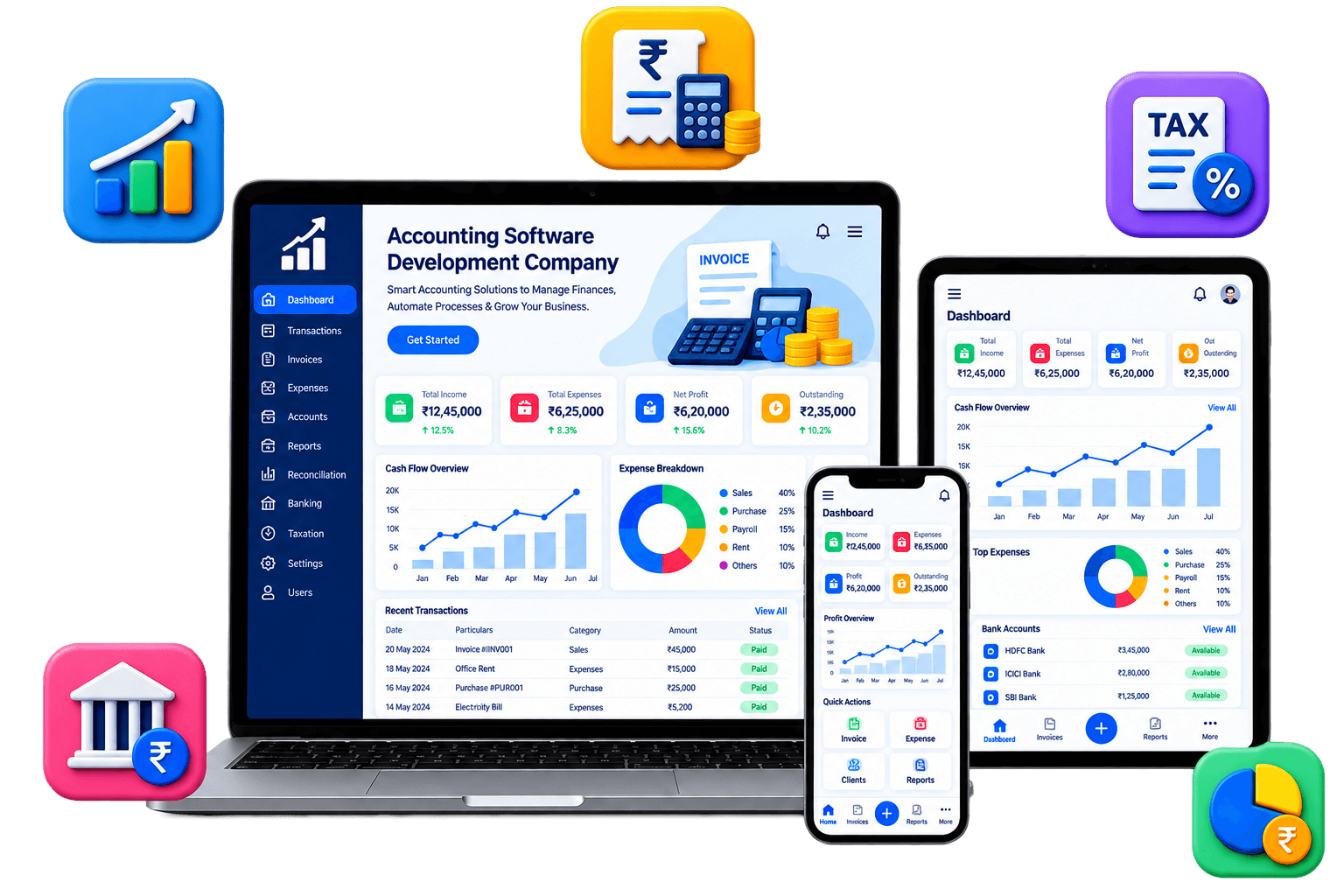
Most accounting software problems do not begin with a lack of features. They begin when the software does not reflect how your accounts team actually posts entries, reconciles bank statements, files GST returns or closes a month. Teams then fall back to spreadsheets, manual journal registers and disconnected bank records, leaving management without accurate, real-time financial visibility.
Vibrant Web Tech builds accounting systems around the way your business actually manages its books. We map chart of accounts, approval hierarchies, tax rules, banking workflows and reporting needs before deciding what belongs on each screen. The result is easier for accountants and finance teams to adopt because routine entries take fewer steps and every record stays traceable and audit-ready.
Our accounting software development services are available to businesses across India. A project can begin with a focused ledger and GST filing system, then expand into bank reconciliation, expense management, multi-branch consolidation or ERP-linked accounting as the need becomes clear.
Your accounting system can include only the modules your business needs today, with an architecture that leaves room for sensible growth as transaction volume increases.
Maintain a configurable chart of accounts with accurate journal entries, postings and trial balance reporting.
Track input and output tax correctly, generate GST-ready reports and support timely, accurate return filing.
Import bank statements and reconcile transactions against ledger entries to catch mismatches early.
Capture expenses, vendor bills, approvals and payment schedules with clear outstanding payable tracking.
Track customer invoices, outstanding balances, ageing and follow-ups for faster collections.
Generate profit and loss, balance sheet, cash flow and department or branch-wise financial reports.
We configure chart of accounts, tax rules and workflows for your operation instead of presenting every business with the same fixed accounting template.
Chart of accounts, approvals and postings reflect how your accounts team actually works.
Responsive screens keep entries, approvals and reconciliation fast for accountants and finance staff.
Role-based permissions restrict ledgers, financial reports and sensitive actions according to responsibility.
Connect compatible banking, billing, payroll, GST filing or ERP systems for consistent financial data.
A modular approach allows new branches and features to be added without rebuilding the entire system.
Maintenance, monitoring, issue resolution and planned improvements help the software remain dependable at scale.
We speak with accountants and finance heads to map chart of accounts, tax rules, approvals and current pain points.
We define modules, tax logic, data fields and integrations, then validate key ledger and reporting screens.
The software is built in planned releases while postings, permissions, reports and integrations are tested.
We clean and map agreed financial data, train the accounts team, launch carefully and monitor accuracy.
The cost depends on transaction volume, tax complexity, modules, integrations, data migration and support requirements. A focused ledger and GST system costs less than a full platform with reconciliation and multi-branch consolidation. We prepare an estimate after a discovery discussion and scope review.
A focused ledger and GST filing system may take a few weeks to months, while a full accounting platform with bank reconciliation and multi-branch reporting takes longer. The practical approach is to prioritise essential postings and expand in stages.
Possibly. We first review the current product, technology, source-code access, licensing and API or database limitations. If safe customisation is not practical, we explain the migration or integration options before recommending a rebuild.
Yes, when the relevant provider offers suitable and authorised integration methods. We assess APIs, data ownership, security and ongoing provider costs before confirming an integration.
Yes. We map existing records to the new chart of accounts, check duplicates and incomplete entries, test a sample import and validate opening balances before the final migration. Clean source data makes the process faster and more reliable.
We build the tax logic in a configurable way so rate or rule changes can be updated without rebuilding the system, and we can support ongoing updates as part of maintenance.
Yes. We provide training for accountants and finance staff on agreed features, and can support the software after launch through maintenance, monitoring, fixes and planned improvements.