Question Bank Management
Build and organise questions by subject, topic, difficulty and format, then reuse approved questions across multiple exams without creating the same content again.
We build reliable online examination platforms for institutes, universities, recruiters and certification providers, with practical controls for test creation, candidate verification, evaluation and result management.
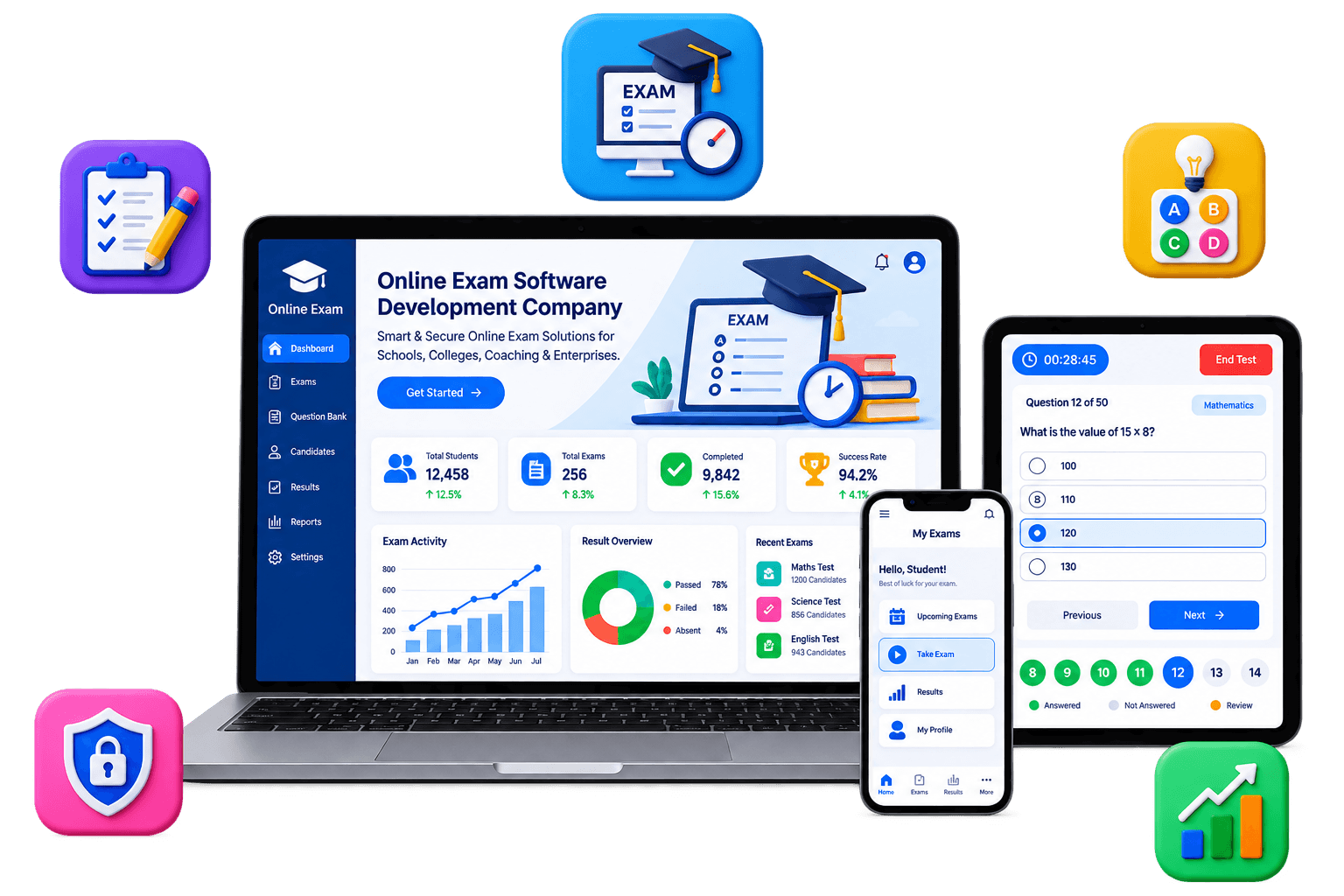
A digital examination involves much more than displaying questions on a screen. Candidate onboarding, test rules, browser behaviour, time limits, answer saving, connectivity interruptions and result access all affect whether an assessment can be trusted. If these details are handled poorly, coordinators spend the exam resolving avoidable issues instead of supervising it.
Vibrant Web Tech plans the platform around the way your examinations are conducted. We document candidate categories, question formats, marking rules, invigilation needs and approval steps before development begins. This keeps the interface straightforward for candidates while giving exam teams the controls and evidence they need.
Our online exam software development services are available across India. The first release may cover question banks, scheduled tests and automated scoring, then grow to include remote proctoring, descriptive-answer review, certificates, multilingual exams or integration with an existing LMS, ERP or recruitment system.
We develop practical examination tools around your subjects, batches, evaluation process and candidate volume, so every feature has a clear role on exam day.
Build and organise questions by subject, topic, difficulty and format, then reuse approved questions across multiple exams without creating the same content again.
Use suitable webcam monitoring, tab-switch alerts, identity checks and browser controls to flag suspicious activity during remote examinations.
Shuffle questions and answer choices for each candidate, making direct answer sharing more difficult while keeping the assessment rules consistent.
Calculate objective scores as soon as an attempt is submitted, while descriptive responses move to assigned evaluators for structured manual review.
Compare topic-wise, question-wise and candidate-wise results to identify learning gaps, difficult questions and areas that need further attention.
Schedule assessments for selected batches or groups with defined access windows, duration and attempt limits, allowing several exams to run without confusion.
The platform can be configured for academic, recruitment, training or certification use without forcing every organisation into the same examination process.
Role permissions, protected sessions, activity records and secure deployment are planned around the sensitivity of your exams.
Frequent answer saving and clearly defined recovery behaviour reduce disruption when a candidate faces a temporary connection issue.
Question and option randomisation, timed sections and controlled attempts support a consistent assessment process.
Responsive, accessible screens keep instructions, progress, navigation and submission status easy to understand.
Connect suitable LMS, ERP, payment, email, SMS or identity services through supported APIs.
Architecture, load testing and deployment choices are aligned with expected concurrent candidates and growth.
We map exam types, candidate journeys, question formats, marking rules, user roles and peak load expectations.
We define the platform structure and validate important screens for coordinators, evaluators and candidates.
Modules are built in planned releases and tested for permissions, scoring accuracy, device behaviour and performance.
A controlled pilot confirms the full workflow before launch, followed by training, monitoring and ongoing support.
Cost depends on candidate volume, question types, exam rules, proctoring requirements, integrations, reporting and support. We estimate the project after documenting the assessment workflow and priorities.
A focused platform with a question bank, scheduled tests and automated results can be delivered sooner than a system with remote proctoring, descriptive evaluation and multiple integrations. We confirm milestones after the scope and technical risks are reviewed.
Yes, provided concurrency is planned from the beginning. We use expected candidate numbers, question and media usage, submission patterns and hosting constraints to design and load-test an appropriate deployment.
Yes. It can support single or multiple-choice questions, true or false, fill-in responses and descriptive answers. Objective answers can be scored automatically, while descriptive responses can follow an evaluator workflow.
Remote proctoring can be added when it suits the exam and applicable consent, privacy and operational requirements. The exact approach may include identity checks, browser controls, live monitoring or recorded evidence for authorised review.
Yes, when the existing system provides suitable APIs or an approved data-exchange method. We first review authentication, candidate data, course or exam mapping, result transfer and error-handling requirements.
Yes, when the question bank and interface content are provided or translated for each language. We plan the multilingual structure early, since retrofitting language support after a platform is built usually means reworking the question bank format.
Yes. We train agreed administrator and evaluator roles, document essential workflows and can provide post-launch monitoring, maintenance, issue resolution and planned improvements.