Yarn to Fabric Production Tracking
Track consumption, beam-wise production, loom allocation and shrinkage across every stage of manufacturing.
We build textile ERP software around how your mill or unit actually runs production, job work and costing, not a general manufacturing template that ignores what makes textile operations different.
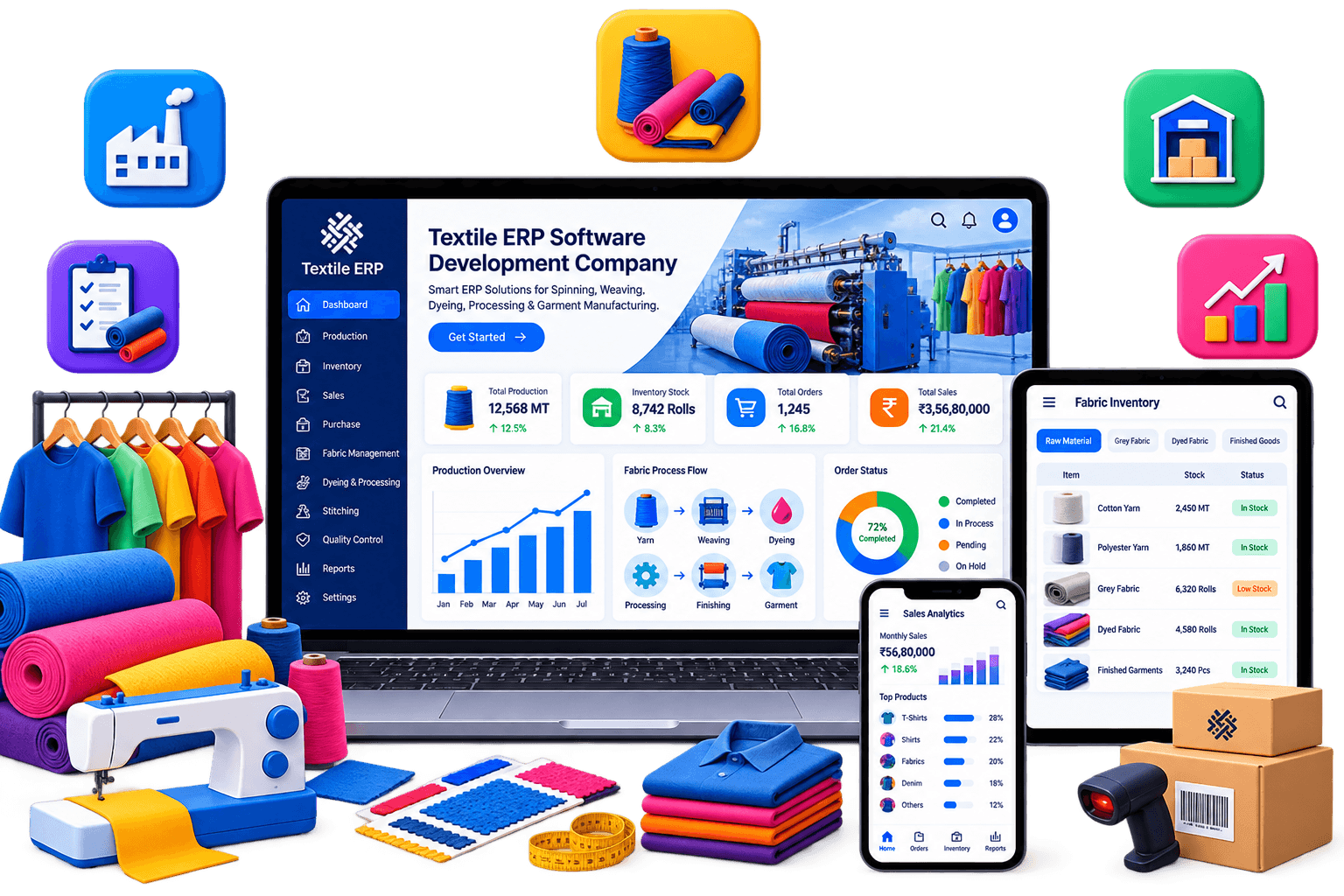
A standard ERP counts finished units. A textile business counts meters, kilograms, and sometimes both for the same lot at different stages, because a roll of grey fabric weighs one thing and measures another after processing. Add job work sent out to a dyeing or printing unit that comes back with some shrinkage and a different lot number, and most off-the-shelf ERP systems start producing numbers that nobody on the floor actually trusts.
We spend time on the shop floor and with your costing team before writing any module, because that is where the real complexity lives. How is yarn consumption actually calculated against a beam. What happens when job work fabric returns short of what was sent. How does your costing team currently account for process loss between grey and finished stages. These are not edge cases in textile manufacturing, they are the daily reality that generic software was never built to handle.
We have built systems for weaving units, processing houses, and composite mills that handle everything from yarn procurement through to finished fabric dispatch. Some engagements start with just production and job work tracking. Others need full costing tied to actual consumption, multi-unit inventory across owned and job work locations, or dyeing house-specific batch and shade tracking from day one. The right starting point depends on where your actual bottleneck is today.
If your business already talks in taka, thaan, grey fabric and jobwork challans, whether you are based in Surat, Bhiwandi, Ichalkaranji or running a unit elsewhere in India, generic software built for standard manufacturing rarely fits without heavy workarounds. GST-compliant billing, export documentation and lot-wise stock tracking get built in from the start rather than bolted on after the fact.

Not every textile business needs every module below immediately. We build around your actual process, whether that is weaving, processing, or a composite operation.
Track consumption, beam-wise production, loom allocation and shrinkage across every stage of manufacturing.
Send and receive job work with proper challans, track quantity variance and reconcile what actually came back.
Track shade cards, batch recipes, process loss and quality checks specific to dyeing and finishing operations.
Calculate real cost per meter or kilogram accounting for actual consumption and loss, not assumed averages.
Track stock across owned units, job work locations and warehouses in the units your business actually uses.
See loom-wise output, job work turnaround, process-wise cost, margin by order, and GST-compliant invoicing for domestic or export orders.
This matters most for operations where a generic ERP has already been tried and abandoned because it could not represent how the process actually works.
Whether it is weaving, dyeing, or a composite operation, the system reflects your specific production flow.
Cost per unit is calculated from actual consumption and process loss, not estimates from a spreadsheet.
Loom operators, job work coordinators and costing staff each see what is relevant to their part of the process.
Integrates with compatible accounting software or existing systems where it genuinely makes sense.
Start with production and job work tracking, then add costing depth or multi-unit inventory as needed.
We stay involved after go-live to adjust the system as your process or product mix changes.
We spend time with production and costing staff to understand how consumption, job work and loss are actually tracked today.
We map modules, units of measure and costing logic, then validate key screens against real production scenarios.
The system is built in stages and tested against actual production data, not just office demonstrations.
We launch with training for floor and costing staff, then stay on to adjust as your operation evolves.
It depends mostly on how many process stages need tracking, whether job work and dyeing batch management are involved, and how deep the costing logic needs to go. We give a real estimate after understanding your actual process, not a generic package price.
Most general ERP systems assume one unit of measure and straightforward finished-goods counting. Textile production involves weight and length changing across stages, job work variance, and process loss that generic systems were not built to represent accurately.
Yes. We track what is sent out, what comes back, and the variance between them, so job work reconciliation is based on actual figures rather than assumptions.
Yes, GST-compliant invoicing is built in, and export documentation such as shipping bills can be added for units that export finished fabric or garments.
Yes. The core approach, building around your actual process and units of measure, applies whether the business is a spinning mill, weaving unit, dyeing house or garment manufacturer.
Yes, that is usually one of the more valuable parts of the system. Costing built on actual consumption and recorded loss gives a far more accurate margin picture than standard cost assumptions.
A focused production and job work tracking system can take a few months. Adding detailed process-wise costing and multi-unit inventory takes longer. We usually recommend starting with the process that is causing the most confusion today.
Yes. We map what you currently have, check for gaps or inconsistencies, and validate a sample before moving everything over.
Yes. Product mix and processes change over time, so we stay available for fixes, adjustments and support after launch.