Lead Management
Capture enquiries from forms, campaigns or manual entry; remove duplicates and assign the right owner.
We design and develop custom CRM software that brings leads, conversations, follow-ups, sales activity and customer service into one dependable system built around your team.
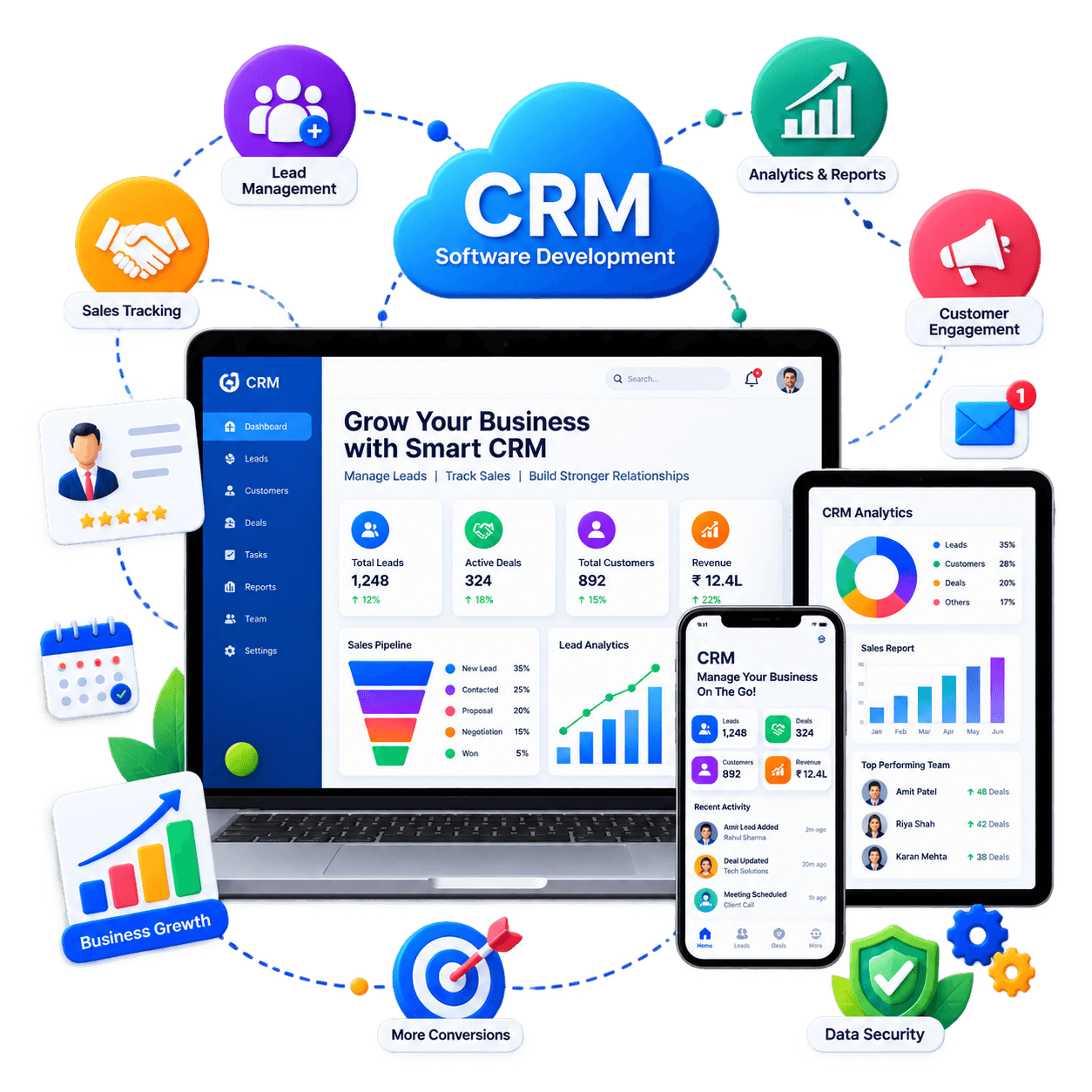
Most CRM problems do not begin with a lack of features. They begin when the software does not reflect how a team qualifies an enquiry, assigns ownership, schedules the next action or moves a deal forward. People then return to spreadsheets, personal notes and chat messages, leaving management with an incomplete view of the pipeline.
Vibrant Web Tech builds CRM systems around the way your business actually works. We map lead sources, stages, responsibilities, approvals and reporting requirements before deciding what belongs on each screen. The result is easier for teams to adopt because routine work takes fewer steps and the information they need stays close at hand.
Our CRM development services are available to businesses across India. A project can begin with a focused lead and follow-up system, then expand into quotations, orders, support, field activity, partner management or other connected workflows as the need becomes clear.
Your CRM can include only the modules your team needs today, with an architecture that leaves room for sensible growth.
Capture enquiries from forms, campaigns or manual entry; remove duplicates and assign the right owner.
Define practical stages, deal values, probabilities, next actions and reasons for won or lost opportunities.
Schedule calls and meetings, trigger reminders and automate selected assignments, alerts and routine actions.
Keep contacts, communication, documents, purchases, support history and open activity in one record.
Track source quality, conversions, pending follow-ups, ageing deals, team activity and forecast values.
Manage complaints, service requests, priorities, assignments, response history and resolution status.
We configure terminology, permissions and workflows for your operation instead of presenting every industry with the same pipeline.
Stages, roles, validations and handovers reflect how work moves through your organisation.
Responsive screens keep common actions straightforward for office, remote and field teams.
Role-based permissions restrict records, reports and sensitive actions according to responsibility.
Connect compatible websites, email, telephony, messaging, accounting or other business platforms.
A modular approach allows features and teams to be added without rebuilding the entire system.
Maintenance, monitoring, issue resolution and planned improvements help the CRM remain dependable.
We speak with stakeholders and users to map lead sources, stages, exceptions, reports and current pain points.
We define modules, roles, data fields and integrations, then validate important screens and journeys.
The CRM is built in planned releases while workflows, permissions, reports and approved integrations are tested.
We clean and map agreed data, train users, launch carefully and monitor adoption and technical performance.
Ready-made platforms suit standard sales processes and get you started quickly. A custom CRM is worth building when your workflow, approvals, industry terminology or integrations don't fit a generic pipeline, or when licence costs grow faster than the value you get as your team scales. We can review your current process and give an honest recommendation either way.
The cost depends on user roles, modules, workflow complexity, reports, integrations, data migration and support requirements. A focused CRM for one team costs less than a multi-department platform. We prepare an estimate after a discovery discussion and scope review.
A clear first version may take a few months, while a larger CRM with migration and several integrations takes longer. The practical approach is to prioritise essential workflows, release them in stages and incorporate user feedback before expanding.
Possibly. We first review the current product, technology, source-code access, licensing and API limitations. If safe customisation is not practical, we explain the migration or integration options before recommending a rebuild.
Yes, when the relevant provider offers suitable and authorised integration methods. We assess APIs, data ownership, messaging rules, security and ongoing provider costs before confirming an integration.
Yes. We map columns to CRM fields, check duplicates and incomplete records, test a sample import and validate totals before the final migration. Clean source data makes the process faster and more reliable.
Security is planned around the deployment and risk profile. Common controls include authenticated access, role-based permissions, encrypted connections, validation, backups, logging and timely software updates. Specific compliance obligations should be identified during discovery.
Yes. We provide training for agreed user roles and can support the CRM after launch through maintenance, monitoring, fixes and planned feature improvements.