Property-Led Website Design
A responsive visual system shaped around the property’s positioning, destination, architecture and guest segments.
Travellers compare rooms, location, amenities, reviews and cancellation details before they commit. We turn that decision process into a fast mobile journey that presents your property clearly and leads guests towards direct contact or booking.
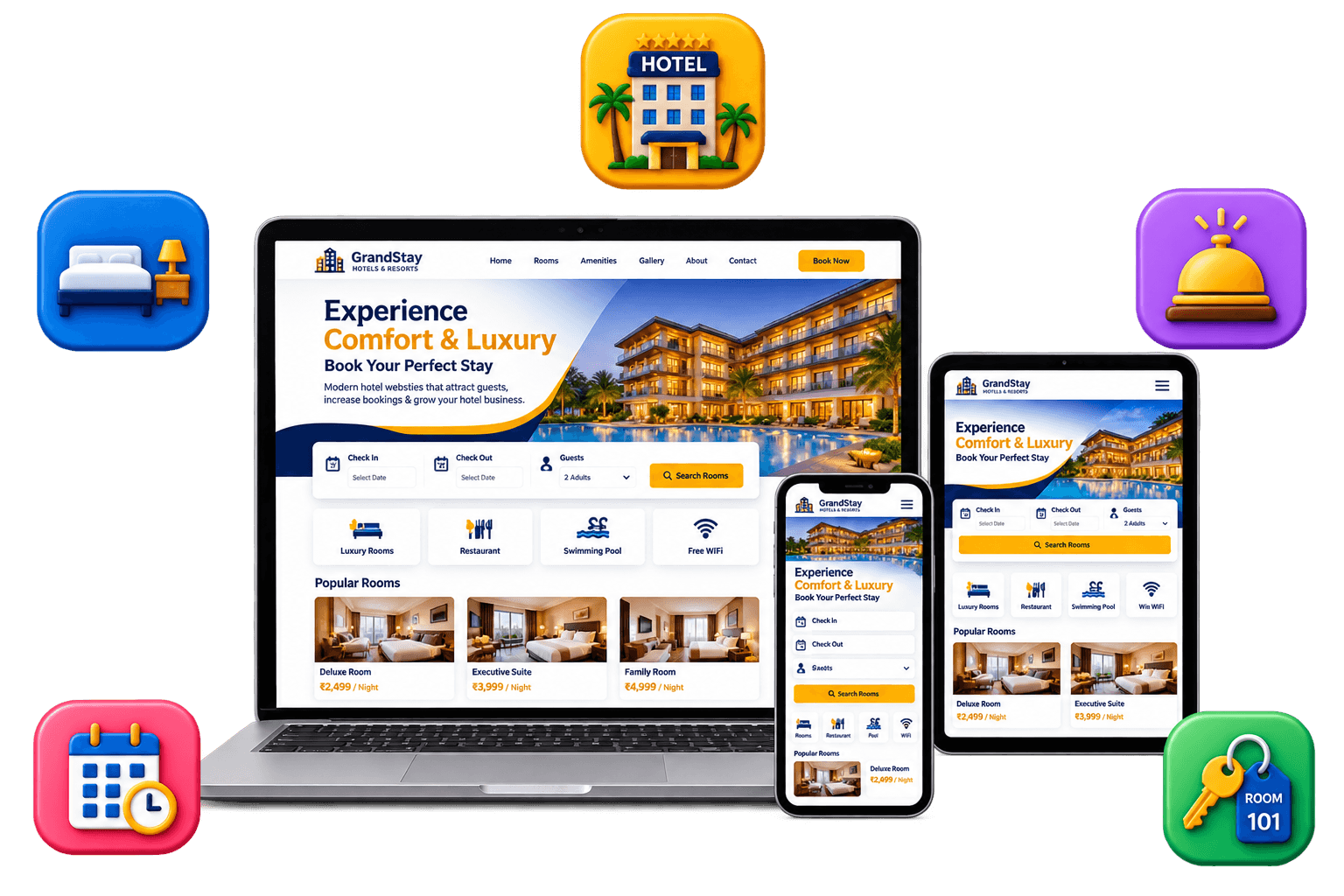
An OTA listing can introduce a hotel, but it rarely communicates the complete experience or gives the property full control over the guest relationship. A dedicated website provides room for stronger photography, accurate policies, destination guidance, packages and the details that help a traveller decide whether the stay suits their trip.
We organise the website around actual booking questions. Guests can compare room categories, check occupancy and amenities, understand location advantages and reach the correct reservation action without navigating promotional clutter. Business travellers, families and destination guests may follow different paths, so the structure reflects the property’s priority markets.
The website also needs to work for hotel operations. Staff should be able to update offers and content, while the selected booking engine, enquiry process or payment connection must fit the existing reservation workflow. We review those practical requirements before recommending technology.
The project combines property presentation, direct-booking pathways and manageable content for day-to-day hospitality marketing.
A responsive visual system shaped around the property’s positioning, destination, architecture and guest segments.
Present occupancy, bed configuration, amenities, inclusions, policies and relevant room imagery consistently.
Connect a compatible reservation tool or create a clear enquiry process suited to current operations.
Show dining, events, wellness, meetings and activities with details that support guest decisions.
Combine directions, travel information and nearby attractions to assist planning and location-based search.
Measure important room, offer, contact and booking actions using the supported tools selected for the project.
The website can be adapted to independent properties, distinct guest segments and multi-property hospitality operations.
Room comparison, calls, maps and booking actions remain easy to use while travellers plan on a phone.
Media is sequenced to answer guest questions and communicate atmosphere instead of becoming an unstructured gallery.
Room details, policies, amenities and destination information reduce uncertainty before reservation contact.
Property, accommodation, facility and destination pages are structured around relevant search intent.
Promote direct packages and inclusions with clear conditions instead of depending only on third-party listing formats.
A suitable architecture can accommodate new hotels, destinations and shared brand content as the group expands.
We review room inventory, guest segments, facilities, reservation operations, offers and available content.
Rooms, experiences and destination information are organised before mobile-first page designs are approved.
The website, CMS, media and supported booking, payment or enquiry connections are implemented and tested.
Staff receive content guidance while devices, forms, tracking and complete booking pathways undergo final checks.
Yes. Key pages such as rooms, policies and booking information can be built to support additional languages, depending on which guest markets the property wants to prioritise.
Cost depends on room categories, properties, custom design, languages, booking setup, photography volume and integrations. We review the property and reservation workflow before proposing an appropriate scope and quotation.
Yes, when the provider offers a supported widget, link or API and the hotel has suitable account access. We review documentation, mobile behaviour and tracking capability before confirming the integration.
This may be handled by a compatible booking engine or approved payment gateway, depending on the reservation model. Provider onboarding, payment security and cancellation or refund operations must be agreed before implementation.
Yes. A CMS can provide authorised staff with structured controls for rooms, facilities, packages, galleries and destination content while preserving layout consistency.
A strong direct website gives guests another trustworthy booking path and supports direct marketing, but it does not guarantee a specific shift in bookings. Results also depend on pricing, availability, reputation, campaigns and reservation response.
Yes. We can plan a group website with individual property pages, shared brand content, location search and separate booking actions. Complexity depends on the booking platform and how inventory is managed.
We include core technical and on-page SEO foundations. Ongoing support can cover updates, backups, performance, issue resolution and improvements; broader content and search campaigns can be scoped separately.